Whole-house filtration starts with a clear treatment goal. Are you comparing options for taste and odor, sediment or a specific documented filtration need?
The right system depends on the incoming water, selected filter media and the flow your home needs. Discuss those details before choosing a package.
A whole-house system treats water near its point of entry, before the connected household fixtures. Which fixtures receive treated water depends on the plumbing arrangement.
The filter's job is determined by its media and documented capabilities. Some equipment targets particles; other equipment is selected for particular taste, odor or chemical-reduction goals.
"Whole-house" describes where treatment is applied. It does not mean the system removes everything from the water.
Start With the Problem You Want to Address
Taste and Odor
Describe what you notice and whether it affects hot water, cold water or a single fixture. A new or unexplained change may need investigation before equipment is selected.
Sediment or Particles
Identify where particles appear and whether they are recurring. A filter should not be used to hide an unresolved plumbing or supply problem.
A Specific Treatment Target
If you want reduction of a particular substance, compare the exact model's documentation and applicable certification claims.
Several Goals at Once
A combined setup may include filtration, softening or drinking-water treatment. Each stage should have a defined purpose.
Sediment Filtration and Carbon Filtration
Sediment Filters
Sediment filters are selected to capture particles within their stated specifications. Filter fineness, flow capacity and replacement needs must be considered together.
A finer filter is not automatically better for every property. Selection should account for pressure and service requirements.
Carbon-Based Filtration
Carbon media may be used for certain taste, odor and chemical-reduction goals. Performance depends on the media, equipment design and operating conditions.
Do not assume all carbon filters have the same capabilities.
Chloramine Considerations
IRWD uses chloramines in its water supply. If chloramine reduction is the goal, check evidence for the exact system at the intended flow and use conditions.
A general claim about chlorine reduction does not establish equivalent chloramine performance.
Not every carbon or sediment filter reduces the same substances. Check the manufacturer's performance data sheet and the exact model's certifications. NSF/ANSI 42 commonly covers specific taste and odor claims, while NSF/ANSI 53 covers specified health-related contaminant reductions. A certification does not mean a filter removes everything.
Whole-House Filtration Does Not Automatically Soften Water
A whole-house filter should not be assumed to reduce calcium and magnesium hardness.
If mineral deposits are the main concern, compare filtration with softening or conditioning. A combination system may be appropriate for several goals, but the components perform different jobs.
Confirm where water enters the home and which branches would be treated. Review outdoor irrigation and other connections separately where relevant.
Available Space
Allow room for tanks or housings, connection work and future filter changes.
Bypass and Shutoffs
The installation should provide appropriate access for isolating and servicing equipment.
Drainage and Power
Requirements vary. Some systems need backwashing or other connections; others work differently. Check the proposed model.
Existing Treatment
Review whether a softener, conditioner or other filter is already installed. The arrangement of treatment stages should follow the equipment requirements.
Irvine Water Context
IRWD describes drinking water that meets applicable standards. Filtration decisions should address a defined household preference or treatment goal rather than assume Irvine tap water is unsafe.
Water sources and blending can vary, affecting taste and hardness. The district's report provides supply context; it is not a test of your home's plumbing or installed equipment.
Use official information alongside property-specific assessment.
Compare ongoing upkeep alongside the initial installation price.
Filter and Media Maintenance
Maintenance is part of the system plan.
Cartridges may need replacement, and tank-based equipment may have media or operating requirements. Intervals depend on the product, incoming water and use.
Ask how service needs are identified and whether compatible replacement parts are readily available.
If filtration seems less effective or pressure has changed, review the equipment rather than assuming a standard filter change will solve every issue.
Whole-house filtration treats connected household water near the main supply. Under-sink RO focuses on drinking water at a dedicated outlet.
Some households compare both because the goals differ. Review the capability of each system instead of assuming whole-house treatment makes drinking-water equipment unnecessary.
The Homeowner's Problem: Soft Water, but an Unwanted Taste or Odor
Consider a homeowner in Woodbury who already has a working water softener but notices an unwanted taste at the kitchen faucet and a chlorine-like odor when running water.
The homeowner wants to explore filtration for the water supplied throughout the home while keeping the existing softener.
The reported taste and odor are starting points for assessment. They do not establish the cause or mean the water is unsafe.
The Starting Setup
For this example, assume:
The property has a private main-water connection
The existing softener is operating correctly
There is space near the treatment equipment
The plumbing can accommodate an additional treatment stage
Equipment will remain accessible for servicing
The assessment must confirm which fixtures receive treated water and whether outdoor irrigation can remain separate.
These assumptions describe this example, not every Woodbury home.
The Assessment: Identify the Treatment Target
Start by asking where and when the taste or odor occurs.
Does it affect cold water, hot water or both? Is it present at several fixtures or only one? Has it changed recently?
Review utility information alongside checks at the property. Identify whether the proposed treatment target is chlorine, chloramine or another substance before selecting equipment.
Also inspect:
Existing equipment model and service history
Incoming pressure
Pipe size and connection arrangement
Peak household demand
Available installation space
Maintenance clearance
Drain and power access if required
A general carbon-filter description is not enough to establish suitability for every treatment target.
The Proposed Solution: Separate Filtration and Softening
The proposal would evaluate a carbon filtration stage compatible with the identified water conditions and household demand.
The existing softener would remain responsible for hardness reduction. The new filtration stage would address its separately defined treatment target.
The final proposal should identify the exact carbon equipment, media, rated treatment capacity and supporting performance documentation.
A sediment prefilter would be added only if the assessment supports it. Adding more stages without a defined purpose can increase cost and maintenance.
Equipment and Product Details
A proposed carbon system should identify:
Manufacturer and exact model
Carbon or other treatment media
Supported reduction claims
Treatment-flow and capacity information
Connection requirements
Backwash requirements, if applicable
Maintenance and replacement instructions
For an optional cartridge prefilter, the Pentair Pentek 150233 is an example 20-inch Big Blue housing. It has one-inch NPT connections and accepts compatible 20-by-4.5-inch cartridges.
The housing holds the cartridge; the cartridge determines the treatment function. A sediment cartridge should not be described as providing carbon filtration or hardness removal.
Named products are educational examples. Final equipment selection and availability need confirmation.
How the Installation Would Proceed
1
Confirm the treatment goal.
Review the reported concern and choose appropriate assessment methods. Match proposed performance claims to the exact equipment documentation.
2
Review the existing softener.
Confirm its operation and identify how the new filter will connect without interfering with servicing or bypass access.
3
Agree on the equipment and scope.
Identify the filtration model, any justified prefilter, plumbing changes, startup checks and maintenance responsibilities.
4
Install the treatment stages.
Isolate and depressurize the work area. Position and connect equipment in the order required by the selected manufacturers.
5
Complete model-specific startup.
Follow the equipment's filling, flushing and cycling instructions. New carbon equipment may require preparation before normal use.
6
Check performance and operation.
Inspect connections, verify bypass operation and check pressure and flow under relevant household demand. Use an appropriate test for any claimed treatment outcome.
7
Explain ongoing care.
Identify replacement parts, service access and the signs that warrant a maintenance call.
What the Estimate Would Include
Estimate item
Scope to confirm
Carbon filtration equipment
Exact model, media, supported treatment claims and capacity.
Optional sediment stage
Housing, cartridge and reason for including it.
Connection materials
Fittings, piping, bypass and isolation hardware.
Installation labor
Equipment placement and integration with the existing softener.
Drain or electrical work
Only where required by the selected equipment.
Startup and checks
Manufacturer-directed preparation, leak checks and relevant performance checks.
Future maintenance
Consumables, media servicing and equipment-specific requirements.
Taxes and additional work
Clearly identified charges, options and exclusions.
Request a property-specific quote. This example does not establish a verified installed price for the proposed combination.
What Could Change the Price?
Additional work may be needed if:
Existing piping must be rerouted
Space is limited
The selected filter requires a new drain route
Additional electrical access is required
Supply pressure needs attention
Existing bypass hardware is unsuitable
The softener also needs repairs
Finish restoration or equipment removal is required
Ask the proposal to distinguish necessary work from optional upgrades.
The Intended Result and Follow-Up
The intended result is filtration for the identified taste or odor concern while preserving the existing softener's hardness-reduction function.
The example does not promise removal of every contaminant or report invented before-and-after results.
Completion checks should confirm leak-free connections, appropriate operation and accessible service controls. Any treatment measurement should use a method suited to the specific claim.
Maintenance should follow the selected equipment's instructions and actual water use. Cartridge changes, carbon-media servicing and softener maintenance are separate responsibilities.
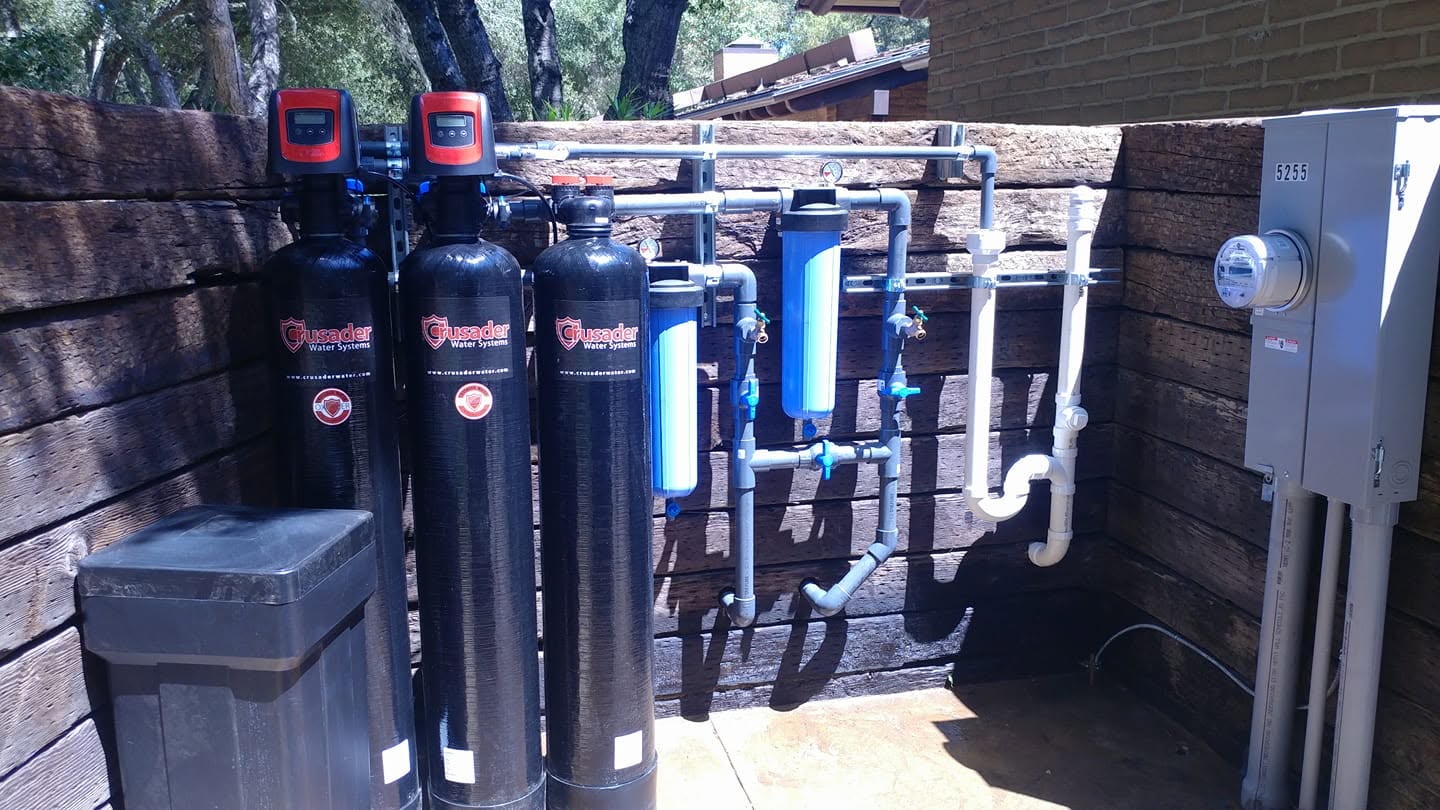
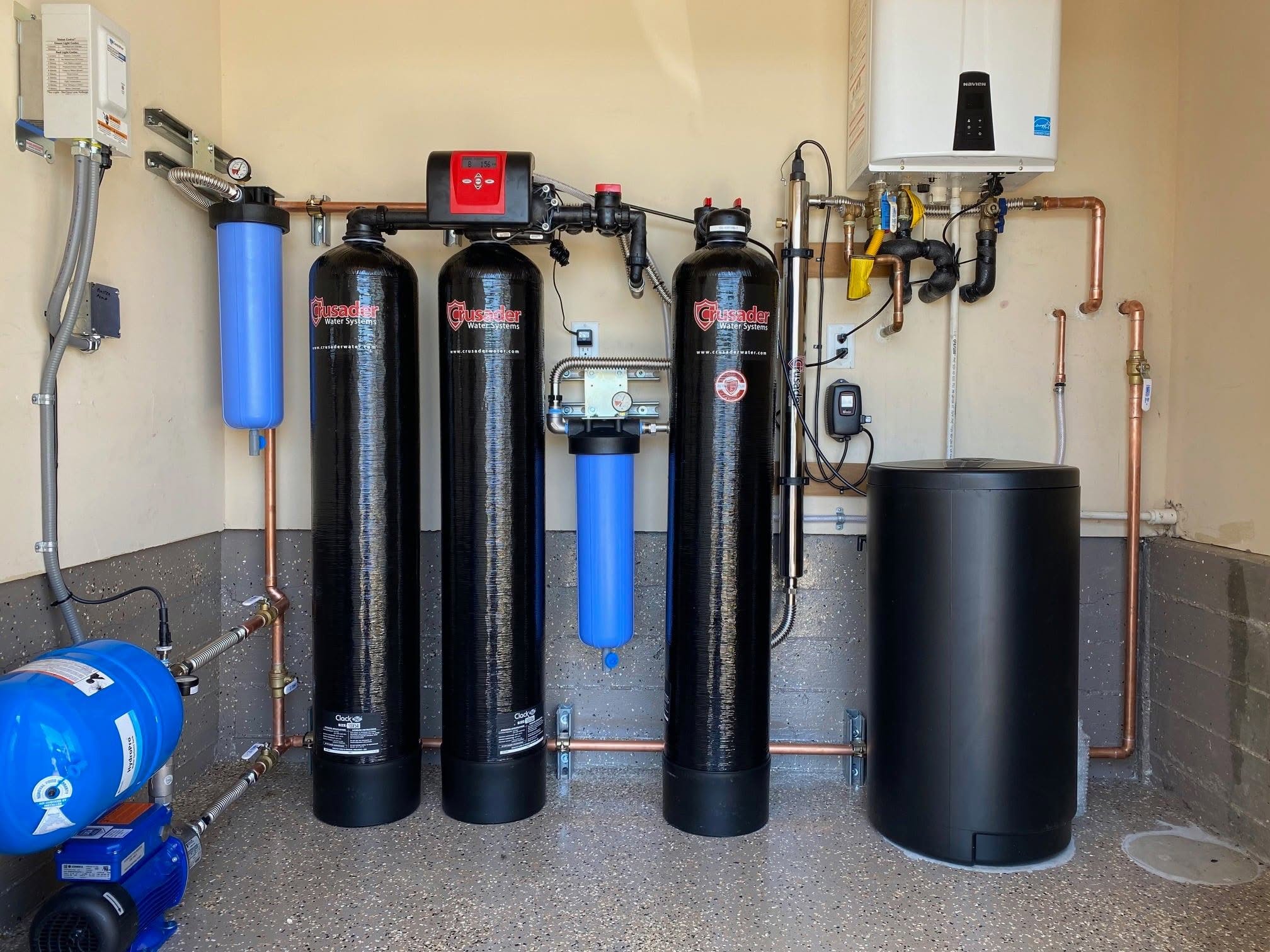
Photographs of genuine whole-house water filtration and multi-stage treatment equipment. Captions describe visible components only.
Outdoor Multi-Stage Treatment & Filtration System
Enclosed outdoor installation showing three Crusader Water Systems media tanks, dual digital control heads, dual inline Big Blue filter housings with pressure gauge and sampling valves, rigid PVC manifold, and air-gap drain piping.
Genuine equipment photo.
Integrated Media, Cartridge & UV Filtration Setup
Installed multi-stage treatment bank combining three fiberglass media vessels, dual inline Big Blue cartridge filter housings, stainless-steel UV disinfection chamber, and booster pump with pressure tank.
Genuine equipment photo.
Frequently Asked Questions
Discuss Whole-House Filtration for Your Irvine Property
Compare treatment goals, equipment capacity and ongoing care before choosing a system. Call Irvine Water Softeners & Filtration Co. to discuss available options and installation planning.